Center For The Cure Of Sweaty Palms
TOLL FREEE: 1 (866) PALM 911 or 1 (866) 725 - 6911
Top Sureeon to Cure of Hyperhidrosis, sweaty palms, underarm & foot sweating Top Sureeon to Cure of Hyperhidrosis, sweaty palms, underarm & foot sweating Top Sureeon to Cure of Hyperhidrosis, sweaty palms, underarm & foot sweating Top Surgeon to Cure of Hyperhidrosis, sweaty palms, underarm & foot sweating
More Information
Success Stories
"Thank you Center for the Cure of Sweaty Palms™. Your staff was compassionate, caring, and very professional. You made me feel like family. I was attended to in prompt and hospitable manner. Everything was thoroughly explained in detail to me. I can't wait to tell everyone how successful my surgery was! You are definitely a Five Star Hyperhidrosis full starsHyperhidrosis full starsHyperhidrosis full starsHyperhidrosis full starsHyperhidrosis full stars Facility!
- Reno, Nevada

Read More
Membership
 
Awards
 
Millions of Americans Suffer from Hyperhidrosis. You are not alone!
Make an appointment. The cure is just a phone call away.

Call us Toll Free:

1 (866) PALM 911 or 1 (866) 725 - 6911
Visit our Hyperhidrosis
 

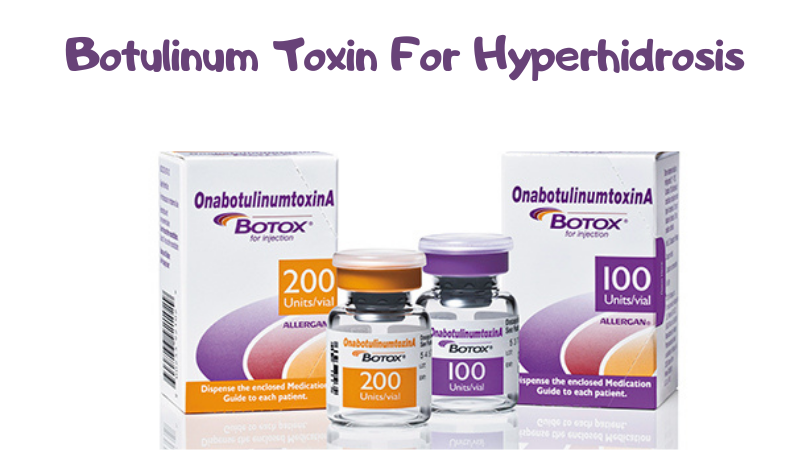
Botulinum toxin for hyperhidrosis?

 
Clinical bottom line
On the basis of limited information from four randomised studies, botulinum toxin appears to be effective for hyperhidrosis

Several strains of botulinum toxin exist, the most commonly used in medicine are botulinum toxin A and B. Botulinum toxin A is commercially manufactured as Botox and Dysport. These are different agents, with one mouse unit of botox being approximately equivalent to three mouse units of dysport. The toxin is licensed as a treatment for a number of indications, mainly dystonias and spasm, but is also commonly used for cosmetic reasons to reduce the effects of ageing. When injected into muscle the toxin blocks the release of acetylcholine at the neuromuscular junction. This reduces muscle tone, which alleviates symptoms. It has been assumed that botulinum toxin will also inhibit other cholinergic mechanisms, such as sweat production. 
Hyperhidrosis is a rare condition in which large quantities of water and electrolytes are exuded from the body. In severe cases, hands and feet may drip with secretions. The condition has a considerable emotional and social burden. When other treatments have failed, surgical intervention is possible but the risk of compensatory sweating in other areas exists. Another possibility is to use botulinum toxin.

Search
PubMed was searched for randomised, double blind, controlled trials of botulinum toxin for the treatment of hyperhidrosis. Free text terms included 'botulinum toxin', 'botox', 'dysport' and 'hyperhidrosis'.

Results
Several studies were identified of which four [1-4] were randomised and double blind and details of these are shown in Table 1 (bottom of page). Three of the four trials scored highly with a commonly used 5-point quality scoring system [Jadad et al, 1996], though they differed in the type of botulinum toxin A, dose, number of injections, duration of observations, and choice of outcome.

Two trials [Naumann et al, 2001; Schnider et al, 1999] were conducted in patients with axillary hyperhidrosis over 13 and 16 weeks, and two studies conducted over four and 13 weeks were in patients with palmer hyperhidrosis.

Outcome data were presented in slightly difference ways in the trials, but all showed greater improvement (reduction in sweating) with botulinum toxin A than with placebo. The largest study [Naumann et al, 2001] reported greater than 50% reduction in axillary sweating from baseline in 198/242 (82%) patients given botulinum toxin and 16/78 (21%) given placebo at 16 weeks. The additional benefit achieved with toxin over that achieved with placebo was 61%, suggesting an NNT of less than 2. Patient global ratings in this study were equivalent to moderate improvement. If information for vaguely similar outcomes is pulled together across other trials an improvement of roughly 30% is shown with botulinum toxin over that occurring with placebo. This could also be regarded as moderate improvement.

Adverse events were relatively uncommon. To note though is that two patients with severe and socially limiting axillary hyperhidrosis experienced increased palmer sweating after treatment with botulinum toxin. Since the toxin decreases muscle tone it is possible that grip strength could be reduced in patients with palmer hyperhidrosis, but there was no evidence of this in the trial by Lowe and colleagues.

Comment
The results are interesting but should be interpreted with caution. The main caveat is that there are limited data at present. With one exception, the studies were small and used within patient comparisons. That doses and outcomes differed also muddies the waters, and it is difficult to say whether the effects of the toxin are greater with increased dose. It does appear, though, that botulinum toxin reduces symptoms in this rare condition. The report of increased palmer sweating in patients with axillary hyperhidrosis should be noted, and it was not reported in the trial whether this subsided as the effects of treatment wore off.

There will be issues of patient selection, since the site and number of injections required will impact on the feasibility and acceptability of treatment. At present this is an off-license indication for botulinum toxin. It does not provide a cure, and repeated injections would be required to limit symptoms in the long-term. In patients with palmer hyperhidrosis, another consideration might be the long-term effects on muscle tone.

References
  1. Lowe NJ et al. Efficacy and safety of botulinum toxin type A in the treatment of palmer hyperhidrosis: a double-blind, randomised, placebo-controlled study. Dermatologic Surgery 2002;28:822-27.
  2. Neumann N et al. Botulinum toxin type A in treatment of bilateral primary axillary hyperhidrosis: randomised, parallel groups, double blind, placebo controlled trial. BMJ 2001; 325:1-4 
  3. Schnider P et al. A randomised, double-blind, placebo-controlled trial of botulinum toxin for severe axillary hyperhidrosis. British Journal of Dermatology 1999;140:677-680. 
  4. Schnider P et al. Double-blind trial of botulinum A toxin for the treatment of focal hyperhidrosis of the palms. British Journal of Dermatology 1997; 136: 548-552. 
  5. Jadad A et al. Assessing the quality of reports of randomized clinical trials: is blinding necessary? Controlled Clinical Trials. 1996; 17:1-12.
 
Bookmark on:
 
 
Se Habla Espanol & NÓi Tiéng Viét

Toll Free: 1 (866) PALM-911


Or: 1 (866)725-6911

Local Tel: (714) 887 - 0150

info@curesweatypalms.com
Hyperhidrosis - Treatment for Hyperhidrosis - Hyperhidrosis Information
 
GENERAL INFORMATION
 
CONTACT US
 
SURGEON'S PROFILE
 
HYPERHIDROSIS INFORMATION
 
BROCHURES
 
ARTICLES
 
HYPERHIDROSIS OR EXCESSIVE SWEATING
 
LINKS
Copyright © 2000-2012 Center For The Cure Of Sweaty Palms™. All Rights Reserved. Home | Sitemap | Terms of Use
Designed by RedAlkemi